In this article
In a world where energy efficiency and reducing greenhouse gas emissions matter more and more, having a software solution that helps you save energy in your industrial process is essential.
But how exactly does a MES help you save energy?
Identify the most energy-intensive shops and departments
The first step is to identify the most energy-intensive shops in your plant.
For Meta 2i‘s customers and partners (especially those producing in France), we have found that the departments using the most energy were:
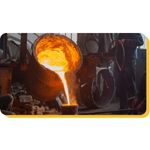
Furnaces, and casting and melting processes

Electrolysis and anodising
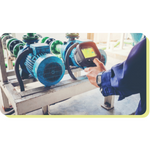
Processes requiring water cooling

Pickling baths
This is because furnaces and melting processes use huge amounts of electricity or gas to run.
Electrolysis and anodising shops are so energy-intensive that it is not unusual to see companies postpone production, sometimes by several weeks. Unless they find other solutions or optimisations (we will see which ones below), they limit themselves to what is strictly necessary or to the most profitable production runs.
In 2022, some companies saw their energy bills double. It is essential to fully understand the commitments and contracts that bind you to your supplier. Take the time to read them again!
How can industrial production software help you?
The KmProd MES and KmEnergy, the tool dedicated to energy efficiency, let you monitor and optimise your process in real time, through optimised management of your gas or electricity consumption.
By analysing your process and identifying areas for improvement, you can make changes that will have a significant impact on your energy consumption.
8 actions: how does a MES help you monitor and adjust your energy consumption?
1
The software collects production data in real time, giving you a reliable picture for your audits, analyses and optimisations. It ensures finer production tracking, closer to what really happens.
2
Production calendars give you a quick overview of the shops in operation and their coming weeks of work. At the same time, you can see consumption by shop, by type of production and by machine or tool.
3
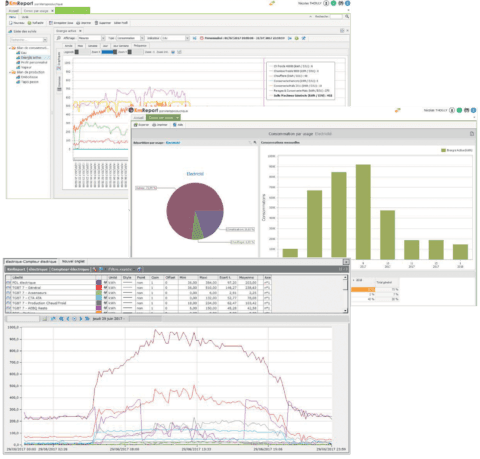
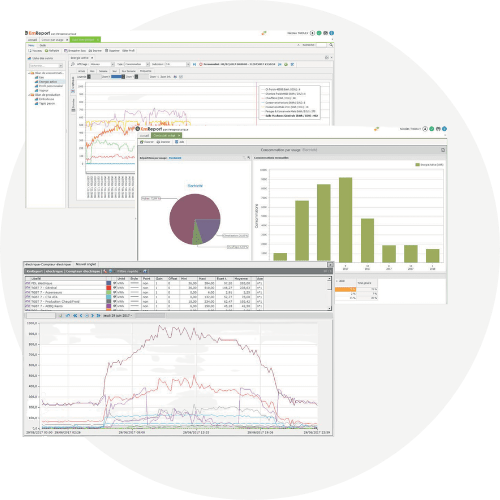
Our user interfaces were designed to give you access to your statistics in a few clicks. With the tables and charts available, you can find out which energy (or combination of energies) a production run used.
4
A MES lets you view measurement acquisition data. At last you will know how profitable your production is once energy consumption has been deducted. You will be able to compare your consumption data with your production data and, no doubt, adjust your processes to be more profitable.
5
Running tests to know when to produce and how to “gain degrees”? Within KmProd and KmEnergy, you can cross-reference data across different production scenarios and tests. For example: identify off-peak hours — should you produce at night? If a furnace drops a few degrees, is production quality affected? If so, is losing a few parts not financially better than the extra consumption cost of the difference? The staff in charge of analysing this data and deciding on measures are comfortable with our interfaces. The charts and tables available can be customised and support several languages and alphabets.
6
Drawing a diagram of your plant may seem trivial, yet it is necessary to get a precise overall view of how it works. With a MES such as KmProd, you can map your shops, lines, machines and equipment as a tree. All that remains is to collect data from your production and structure it (most of the companies we work with already have a lot of data, which is often poorly used and poorly queried).
7
Review your instructions and processes. Do you have concrete feedback on what you have put in place internally? The software can then adapt your instructions to your production.
8
As for managing your temperatures, between furnaces, heating and heat loss, the curves and figures provided by a MES may, for example, lead you to lower the temperature of some machines by a few degrees during large production runs. A real case: during a large run, can the temperature be lowered by 10 degrees? If the manufacturing order takes longer but uses less energy, is it profitable for your plant? These times raise new questions. The MES helps you find the answer.
Which business sectors is this performance tracking software for?

What size of company?
Whether you have ten employees or several thousand, MES energy-tracking software helps companies of all sizes optimise their production by improving quality and the traceability of products and processes.
Which industrial sectors?
The MES is ideal for the aluminium, food, plastics, medical, glass and precision engineering sectors, among others.

What goal?
Reducing costs and lead times concerns most shops. Going paperless is also a real transition and step forward for industry (well beyond simply saving paper). Above all, it avoids data-entry time and errors.
In general, what are the first actions after implementing a MES?

Machine times
To identify OEE, it makes sense to measure the actual times at a workstation. Is it wiser for an operator to enter data manually one hour before a production stop, or to use a machine that performs a complete analysis?
Quickly drawing up an action plan
The MES helps decision-makers and operators decide which task to tackle first.

Optimising when furnaces are switched on and off
To cut their bills, customers shut down their furnaces on Thursday/Friday and only restart them on Saturday/Sunday (off-peak hours). These savings cover the extra wage cost of weekend shifts and improve profitability.
Do CO2 reduction and energy saving go hand in hand?
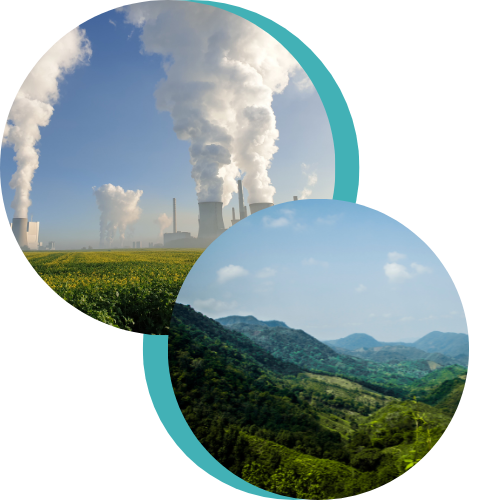
People often think that reducing energy consumption automatically reduces CO2 emissions.
The strategy is more complex than that. It takes investment and a company strategy to optimise 2 or 3 processes that will offset the extra emissions of one step in the production chain.
So you need to think about the process as a whole and create new indicators.
Sometimes a department or shop will be fully optimised for a given operation; you then need to go further and ask other questions related to those operations: where does the energy come from? Where are the materials sourced? Are the work teams properly trained?
When you have to choose between carbon emissions and energy savings, there are probably internal investments to make to strike the right balance between the two, while respecting the company’s brand image.
Keep the goal of maintaining or reducing current costs while increasing the quality of your production. This can also mean reducing your environmental impact while improving your productivity.
In conclusion
Generally speaking, a MES lets you control your processes remotely, which can reduce your energy consumption further. These software solutions can also help you visualise your energy consumption, making it easier to identify other areas for improvement. To learn more about the benefits and how a MES can help you save energy in your industrial process, contact us today.

President of Meta 2i