Why 5G?
5G in factories and shops marks a revival of Industry 4.0. Some are already talking about Industry 5.0 with the rollout of 5G.
What are the strengths of 5G in a shop? Why prepare today for a rollout that looks set to be global? What obstacles and opportunities should be taken into account? This article gives you some pointers to inform your thinking.
Speed and reliability:
Bosch Global gives the following figures on its website:
- Reliability of up to 99.9999%
- Data transfer rates of 20 Gbps,
- Up to 20 times faster than 4G
- Extremely low latency of one millisecond.
These figures alone show how useful 5G is for transferring large amounts of data, but that is not all. Beyond response speed and communication efficiency, flexibility reaches a new dimension, making it possible to combine 5G, Artificial Intelligence (AI) and Big Data.
We have now been accumulating data on our machines and processes for decades. To process it quickly, our software needs fast and reliable channels to carry information. 5G offers the speed of fibre Wi-Fi with the convenience of a phone connection. It also means simpler communication between processes, machines and their sensors (IoT).
Metrology takes on a new dimension: it is no longer limited to measuring and reporting data, but extends to exchanging and interpreting it. Corrections can be applied in real time. This level of detail saves hours on production and maintenance and reduces stress for teams, ultimately improving the effectiveness and efficiency of production, inspection, quality and logistics processes.
5G really comes into its own when combined with AI and Big Data.
New uses of 5G
Delicate operations can now be carried out with complete reliability:
- Driving machinery,
- Running factories,
- Remote surgery,
- Remote training with virtual or augmented reality headsets and glasses
In a way, 5G makes us even more human, by removing the latencies caused by tools, systems and protocols. We can run production with a business leader’s instinct, the power of instrument flying and the comfort of autopilot.
The competitive advantage is striking, because it reduces human error and dependence on certain low-value or uninteresting tasks.
Meta 2i, the IoT (Internet of Things) and AI
Meta 2i has been researching the IoT since 2013 and has been preparing the rollout of 5G for its customers since 2018. Statista forecasts 80 billion connected devices by 2025. A real opportunity for those who know how to capture and understand the data generated, which is there to improve uses and products.
At the same time, Meta 2i has been developing AI solutions for its customers since 2014. Remember the first PLCs, from the 1960s to the 1980s, and the robotics that relieved production of complex and dangerous tasks. Forty years later, AI learns by itself. Where robots relieved the body, AI relieves the mind. It will act on our behalf, leaving us time to think and decide, and above all to understand the reality of production. This is a situation we often encounter at Meta 2i during our audits. Continuous improvement in the processes of many customers who call on our teams is often experimental and empirical: “We did it temporarily and kept it.” All the while missing out on innovations that make life easier by drastically limiting costs.
AI, IoT and 5G are not just for others.
There is still time to get on board, but it will very soon be too late. Do not underestimate the competitive advantage this rollout will give you. Remember too that many of your competitors, peers, suppliers and subcontractors are making the move to 5G. You can be the locomotive or a wagon, but you are on the rails. Either you move forward, or you decide to stay put by doing nothing (or worse, go backwards by deciding it doesn’t concern you when it probably does). Solutions exist, even for small shops.
The benefits of 5G
- Flexible equipment and data
Your machines become mobile. They are tied to walls and floors only by their power supplies, which are not yet wireless. But it becomes quite possible to move a production line temporarily to a specific place, far more easily than before. The sensors, measurement, processing and data reporting move with the machine. It is a new way of looking at production.
- Sensors are faster and better optimised.
They use less energy and are easier to replace, maintain and upgrade. They can also be used at other times when production is not continuous.
- Less need to query the machine, fewer radio calls, fewer phone calls, configurable alerts.
This limits the human interactions that cause misunderstandings, delays and errors, as well as boredom and needless fatigue. Teams and managers appreciate this, and it also helps reduce accidents and incidents on site. What’s more, a good connection makes it possible to protect lone workers (through lone worker protection devices).
- Connected glasses and headsets
5G makes it possible to use new tools that increase teams’ potential. In logistics, for example, the precision of 5G combined with headsets and connected glasses makes it possible to efficiently prepare large numbers of very similar parts on an assembly line. It is also a leap forward for training. No more boring training rooms: the tutorial is now in the headset, spoken and visual. No more multiple-choice questionnaires: you show that you can do it and have understood, and the software can validate the skill. Finally, when troubleshooting or seeking a remote second opinion, 5G makes it possible to send real-time, high-definition video. This also improves safety and speeds up decision-making.
- Autonomous driving: moving people, vehicles and trolleys
No more trolleys pushed by hand or remote-controlled: make way for autonomous trolleys. The same goes for vehicles moving along production routes. The site’s AI, combined with the power of 5G, means heavy trolleys no longer need pushing: once motorised, they become autonomous. They follow you obediently and take the parts selected by the storekeeper to shipping, for example. The same applies to moving people around large sites: instead of driving, you can now enjoy the view or answer your emails.
- Data territoriality and sovereignty.
5G is highly configurable and complies with the GDPR (General Data Protection Regulation). These technologies often come from foreign suppliers, but it is possible to partition data flows so that they do not leave the country. Suppliers have taken this issue on board, and data can be stored wherever you wish, to meet the specifications of certain projects or the requirements of certain customers.
Use case: Meta 2i with an IoT, Cloud and 5G solution abroad
- Meta 2i implemented an IoT + 5G + Cloud solution for the manufacturer Alzamil Plastic in Saudi Arabia (in partnership with the operator Zain Telecom). In this international project, we had the opportunity to promote French software know-how in an environment dominated by American and Chinese giants. Pragmatism and efficiency won the day. The challenge: measure machine performance in real time to make monitoring and decision-making easier. Previously, you had to connect from inside the site to the monitoring tools to access the data. The solution was an IoT platform based on adding different types of sensors to the machines. Coupled with a 5G terminal and industrial tablets next to the machine, it shares information in real time inside and outside the factory, via a cloud. Plant managers can now view performance from their mobile devices and computers. This passive, automatic solution meets high security standards and does not disrupt production. This example shows how 5G can bring non-intrusive solutions that can be deployed very quickly, to everyone’s satisfaction.
At which stages can 5G improve my production?
- Production optimisation
Being able to monitor every stage of production with extremely low latency gives you a better understanding of your production, and so lets you improve it. We all know that production that is perfect on paper never fully survives the test of the shop floor. Combined with the IoT, 5G literally changes the way we think about the factory and production, without calling everything already in place into question. Wireless connectivity also solves many maintenance and accessibility constraints.
- Quality control and safety
Ideally, quality should be checked at every stage of production. In reality, there may be several stages without inspection. What could be more painful than realising it could have been detected earlier? With 5G, and in particular the speed at which data is moved and processed, it is possible to reduce the number of errors drastically with the right sensors and corrective processes.
Data exchanged over 5G, even when it travels over the internet or through mixed channels (Wi-Fi, mobile, software layers), supports high standards of security and encryption.
Finally, a successful 5G rollout improves overall safety on site. Greater responsiveness thanks to faster communication limits incidents, breakdowns and accidents, and also reaction times when an employee is in difficulty or in danger. Lone worker protection devices connected to 5G are far more reassuring than existing systems. On top of this, artificial intelligence can detect behaviour that warrants an alert and limit false alarms.
- Preventive maintenance
To make the most of the move to 5G, sensors need to be installed. These sensors (of various formats and technologies) can also be used for preventive maintenance. 5G makes automated maintenance organisation possible and lets support know exactly what is happening and when, enabling more accurate maintenance planning, ordering the right parts and limiting costs. In addition, the data collected makes it possible to choose the best time for maintenance so as not to slow down or stop production.
- Remote control
5G enables spectacular responsiveness. Since 2019, major surgical operations have been carried out successfully (for example, brain surgery via 5G) or construction machinery operated from the other side of the world). Production managers need to use the potential of these tools to make production more reliable, just as business leaders need this comparative advantage. Finally, imagine being able to replace an absent member of staff with someone who can operate machinery remotely and, eventually, with artificial intelligence, so that no human is exposed to tedious or dangerous tasks any more.
- Human-machine interface
Let’s talk about people. 5G may raise questions, but it serves the women and men in the field. Do we really need it to produce better, more or faster? The answer is simple: no one is forcing you, but why go without it? The iPhone came out in 2007: who “really needed” it at the time? Today, just 15 years later, could you imagine a world without smartphones? The interface has evolved, as have uses, technology, formats, the stability of exchanges — and — the transport channels (3G / 4G / 5G).
5G makes it possible to go beyond what human-machine interfaces allow. We have seen real-time remote control and surgery; now think of the combination with mixed reality, tutorials, the digital twin (a version of yourself, your statistics and skills in the software), autonomous vehicles, or feeding Big Data and AI. The possibilities are many, from the tablet to the augmented reality headset, by way of the “classic” database — the 2030 version.
- Logistics
Among the most effective growth levers, logistics efficiency is one of the most powerful. Being able to deliver faster, assemble more quickly, store less and better, or identify and understand the weak links in your chain will — quite logically — make you more efficient. It also frees you from a burden of thinking and planning, so you can focus on less tedious, higher-value tasks.
- Connectivity of shops and sites
Using data in real time across several sites, being able to query stock and have an exact view of what is in production while anticipating delays and quality failures are what set a 5G-ready factory apart. Saving raw materials and achieving smooth production are possible with 5G solutions coupled with constant querying of internal and external databases, and with the continuous learning that artificial intelligence allows.
Almost everything in a factory can be connected to the 5G network. But it must be thought through and organised to succeed within a reasonable timeframe!
What are the challenges and constraints of rolling out 5G?
- Deploying connectivity that can handle the flow.
The amounts of data exchanged are large and need to be carried efficiently as well as optimised, so that no unnecessary information is sent. In a way, you need to apply to your data what you apply to your logistics.
Replacing antennas, terminals, software and sensors should be considered when moving to 5G-ready production. Is a return on investment guaranteed? If the preliminary study is done properly, you will have the answer. If you rush into 5G without preparation, and above all without support, you risk not getting the most out of the rollout, or worse, getting it wrong.
- Thinking about sensors.
What should be measured? The simplistic answer would be “everything”. But is that really sensible? When curing a plastic or metal part, especially in several stages, each stage counts and deserves to be measured. For “simple” storage, is it better to laser-mark the part? To fit it with an NFC beam, or use chemical marking? The starting point is “Who needs what information, and when?”. Then comes “What can this technology solve?”, and then “How can we reach new heights with 5G?”
- What information should be summarised, and for whom?
Understanding information management is essential in a company. Who needs to know what, and when? Here again the saying “Less is more” holds true. Information tables and data need to be lightened. In the interface of KmProd, Meta 2i’s MES solution, the ergonomics aim to strip out all unnecessary data. Menus let you display everything if needed, but day to day, we seek to free the minds of the operators who use our solutions.
- Planning
Planning is the crux of production. Once planning and 5G are brought together through durable, scalable software, they will drastically reduce production stoppages and increase quality. Imagine being able to run large factories across several sites with the ease of a craftsman in his workshop, who sees his tools and projects in real time and knows what to do, how and by when. Combined with AI and Big Data, 5G makes planning both safer and smoother.
- Informing and involving teams
Rolling out 5G solutions brings significant and lasting changes to how teams are organised. Things can be done gradually, but team buy-in is essential. You need to understand any resistance, explain and demonstrate, prove that it does not call skills and know-how into question, and even prove that 5G makes everyone’s life easier, while making production more reliable and efficient.
- The software question
How does it fit into the existing software ecosystem? Bridges exist, and there are many of them. The MES is a solution that already handles information exchange between machines on the shop floor and ERPs. Some software changes will certainly be needed, but in most cases upgrading certain modules will be enough. Meta 2i knows how to build specific solutions so that you don’t have to replace your entire system, unless that makes more sense. We have been helping our customers with their production since 1989, generating considerable savings over the decades while improving efficiency and effectiveness.
- The cost of deployment
The transformation can be more or less far-reaching, and more or less rapid. Between software, replacing sensors, connectivity, training teams and redesigning the company’s data architecture, deployment can take anything from a few weeks to several months. The payback of such a rollout should be assessed in terms of efficiency and productivity.
If you want to go further, PwC’s “Strategy and Global Digital Operations Study 2018”, from which the following chart is taken, sets out the savings expected from moving to Industry 4.0 — by business sector.
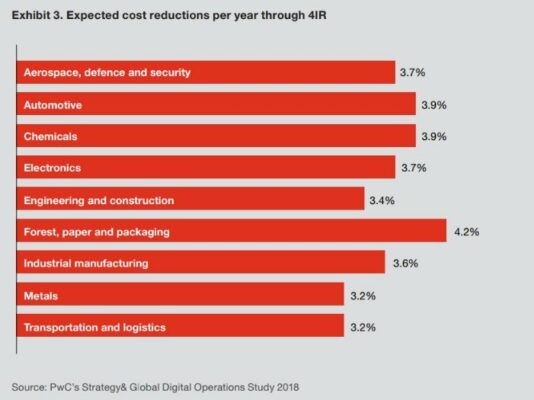
In these challenging times, the figures speak for themselves. Who would turn down a 3.2% annual cost reduction in the metals industry? Companies that adapt in the coming months will pull years ahead of their competitors.

Faisal Bin Dos, Managing Director of Meta 2i
Would you like to talk to our engineers and technicians? It’s very simple, just go to our Contact page!