Like most companies, you probably have ERP (Enterprise Resource Planning) software. The main aim of this tool is to increase the company’s overall performance by understanding and managing it better.
An ERP captures the company’s database so that data inserted or changed in one module affects all the other modules. For example, the main database is updated and the change is applied across the whole company. The ERP is an overall management tool, serving commercial and strategic units.
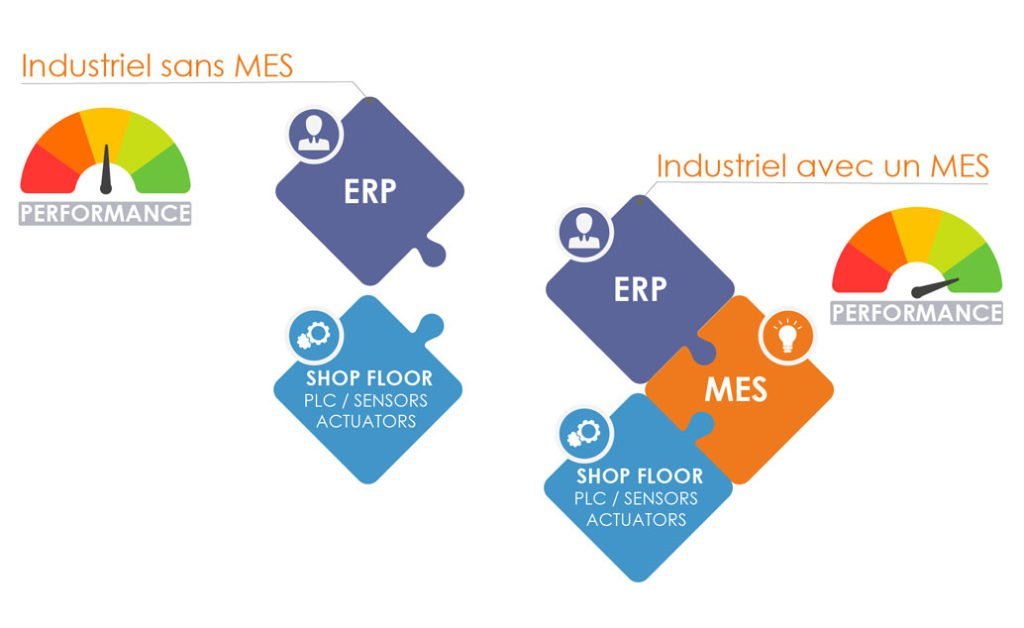
The MES, on the other hand, is production management software. It collects a plant’s or shop’s production data in real time. It can connect, monitor and control manufacturing systems (with complex data flows), both within shops and between different production sites. The result is better productivity and performance for your company.
How the MES and the ERP complement each other:
The MES and the ERP complement each other on several points:
- Data exchange
- Processing and interpreting the data collected
- Strengthening production data.
These two systems can exchange large volumes of data, such as production data (routings, MOs, part numbers, bills of materials, batches and other KPIs) and data on equipment (machines, shops, etc.).
Feeding the ERP with reliable shop-floor data:
What the MES brings to the ERP:
Here is the production process of a company with a MES and an ERP:
The operator launches their MO (Manufacturing Order) and has the information needed to carry out their process. They can follow the progress of their MO in real time and report problems found at their workstation directly.
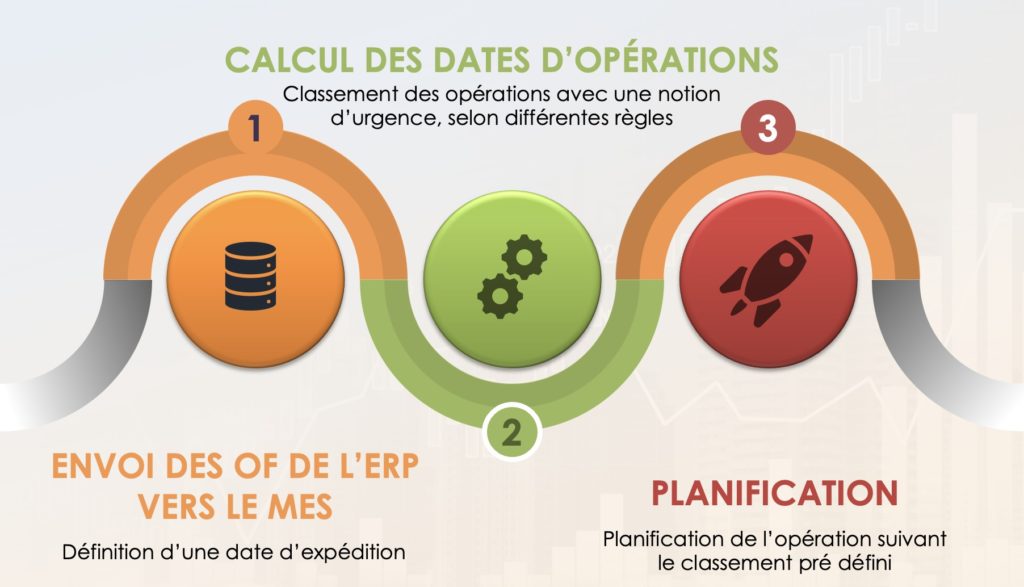
The MES can retrieve the MO directly from the ERP. It can also retrieve the ERP’s production schedule in order to manage it, and can then propose automatic scheduling based on this data.
As for shop-floor supervision, the manager can carry it out using the information available in real time, such as production quantities, the number of rejects, scrap causes, breakdowns / production stoppages (and your own business indicators).
All this data can be sent up to the ERP, so that collecting and processing it makes management easier.
Scheduling management:
Using the data collected in the ERP, the MES can propose scheduling calculated according to production load and configuration (stock, operator availability / absence and skills, predefined duration of future MOs, MOs in progress…).
This configuration can be adjusted as you choose, and alerts can be set up to avoid delays and oversights.
How will KmProd interface with your ERP?
The KmProd software suite, published by Meta 2i, has been working with long-standing customers in several industries since 1989. It is constantly developed to meet each company’s needs and challenges.
Thanks to its cross-sector strategy, the company can adapt to every company’s needs. KmProd must therefore be able to interface with every ERP on the market.

Conclusion:
So no, your MES will not replace your ERP: these tools have different AND complementary functions.
Sometimes both systems may be able to give you the same data. See this as a consolidation of your management tools, like redundancy in aviation.
MES or ERP? Both, captain: you need a tool that projects you into the future and a tool that tells you where you stand in real time.
As for complementarity, KmProd is compatible with the vast majority of ERPs, thanks to the clarity and quality of the data it can produce and summarise.