The history of industrial revolutions
First used in 1837, the expression “industrial revolution” refers to all the developments that, from the 18th century onwards, made the world more modern, in particular through the growth of capitalism, communication tools and production techniques in the West. Today, we can distinguish 4 industrial revolutions, each bringing a major change:

The first industrial revolution: mechanical production
It began at the end of the 18th century with the use of coal, the invention of the steam engine and the birth of new industries, such as textiles. It marked the arrival of mechanisation, which replaced craftsmanship. The steam engine drove machines and allowed higher production rates. All this led to greater output and gave rise to products made in small series.
The second industrial revolution: mass production
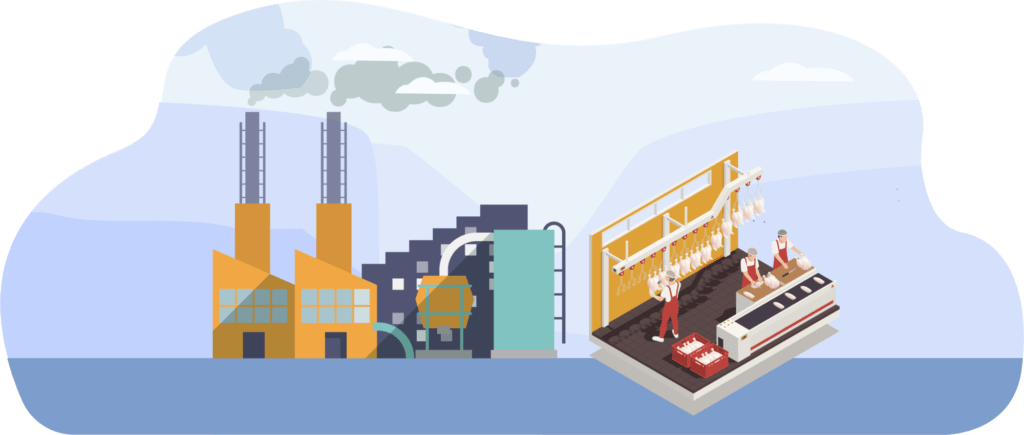
This second revolution appeared at the end of the 19th century. It was based on new energy sources such as electricity, gas and oil, whose use was linked in particular to the internal combustion engine. It was the era of large factories and the division of labour. Taylorism and assembly-line work appeared in these factories, making unskilled workers more productive but also raising questions about the meaning of work.
The third industrial revolution: automated production
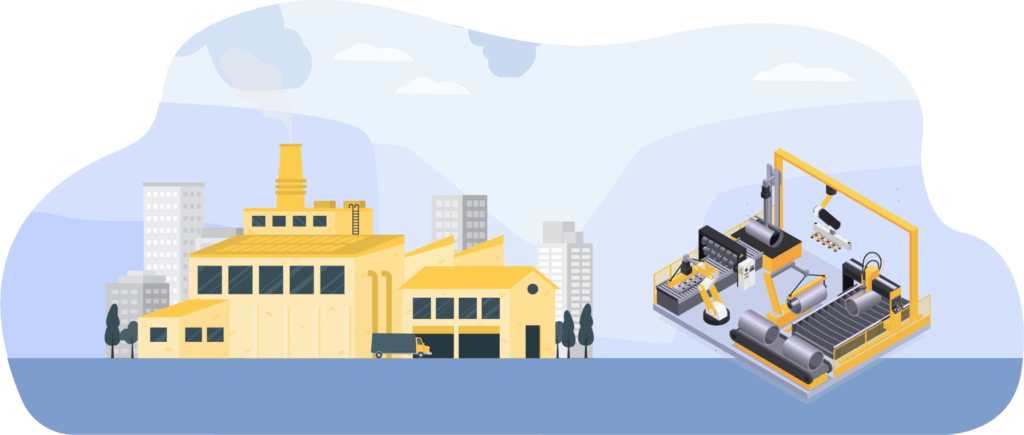
This third industrial revolution appeared in the 1970s, with the development of nuclear energy and the arrival of computing in our daily lives. It was also the beginning of robotics, large-series production and flexible production tools, thanks to extensive automation that relieved operators of certain tasks.
The 4th industrial revolution: Industry 4.0, or the digitisation of information
The 4th industrial revolution has emerged in recent years. It stems from the digitisation of connected devices and brings its share of progress and change, such as nanotechnology, 3D printing and self-driving cars, all of which can be managed by increasingly autonomous artificial intelligence. Despite the many advances, we can still say that we are at the very beginning of Industry 4.0. This new industrial revolution concerns all industrial companies, in every sector and of every size. Their goal is to make a turn that is necessary for their future, in particular by changing how production is managed with new digital tools. This will let them adapt to new consumption patterns, which require the ability to produce customised products in limited series without extra cost.
An industrial revolution driven by several technologies
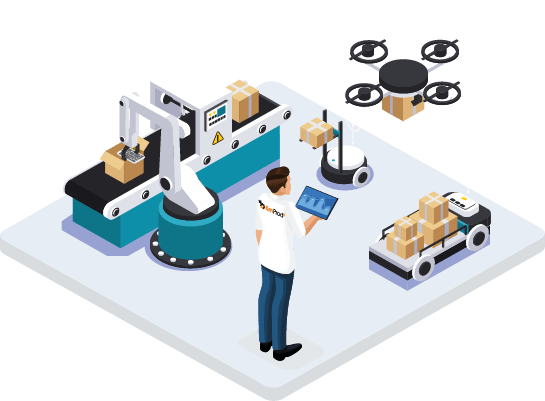
The cobot
The cobot, or collaborative robot, is revolutionising the industrial world. It is both less dangerous and less expensive for factories.
What is it for? The cobot works alongside operators and can take the place of human arms. It is designed to assist the operator and collaborate with them. Easy to program, the collaborative robot can perform different tasks depending on its attachments (grippers, force sensors…).
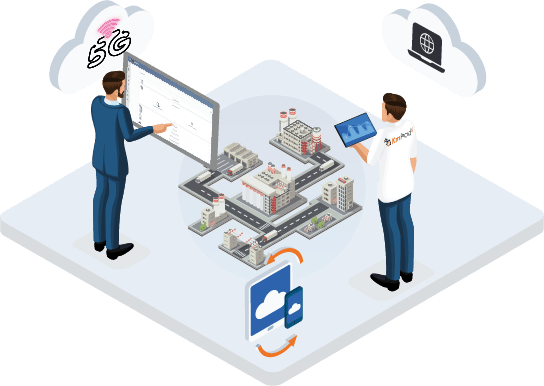
Cloud computing
Cloud computing means accessing IT services such as servers, storage and networking over the Internet. It is an essential element of any Industry 4.0 strategy. The cloud connects production, sales, engineering, the supply chain, distribution and services, giving you the opportunity to process stored and analysed data more efficiently and cost-effectively.
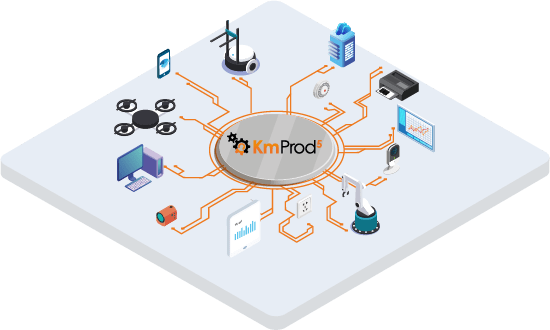
IoT (Internet of Things)
The IoT refers to the network of physical devices — objects with sensors and software — that connect to other devices to collect, analyse and exchange data. It is one of the most decisive elements of smart factories.
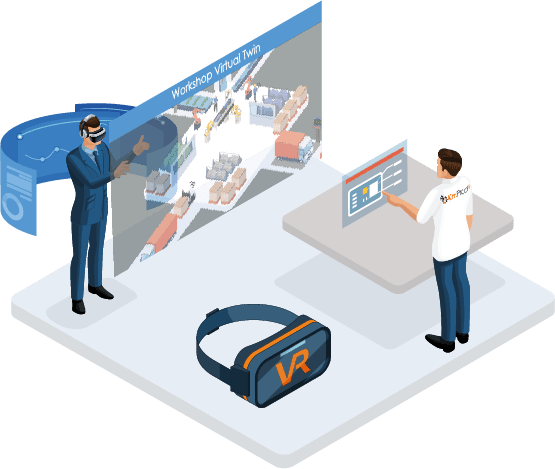
Augmented reality
Augmented reality adds virtual elements to our field of vision, in particular through an augmented reality headset. What does it bring to industry? Mainly, it gives industrial jobs a new look by simplifying and automating certain tasks, with the aim of improving the company’s productivity. Augmented reality has many benefits; here are the main ones:
- Real-time access to data
- Lower error rates
- Less production downtime
- Better productivity
Artificial intelligence
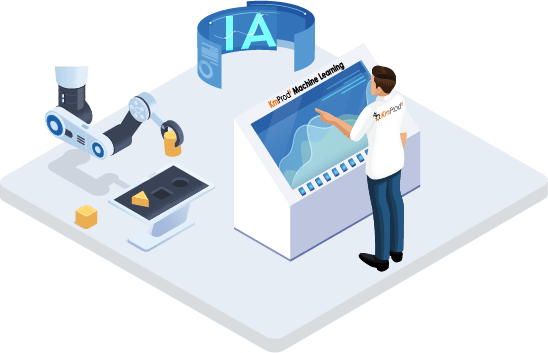
Artificial intelligence lets manufacturers create relevant, evolving information across many operational processes. For example, it enables predictive maintenance through an artificial intelligence algorithm capable of machine learning, which makes it more and more effective.
The MES, an essential first step into Industry 4.0
What is a MES?
The MES (Manufacturing Execution System) is a concept born in the 1980s. Growing rapidly since the 1990s, it has evolved over the decades and taken an important place in Industry 4.0. Its main objective is to optimise activities, from the creation of the manufacturing order to the finished product, and to improve production yield.
The MES is production management software: by collecting a plant’s or shop’s production data in real time, it connects, monitors and controls complex manufacturing systems and data flows, for better productivity and performance.
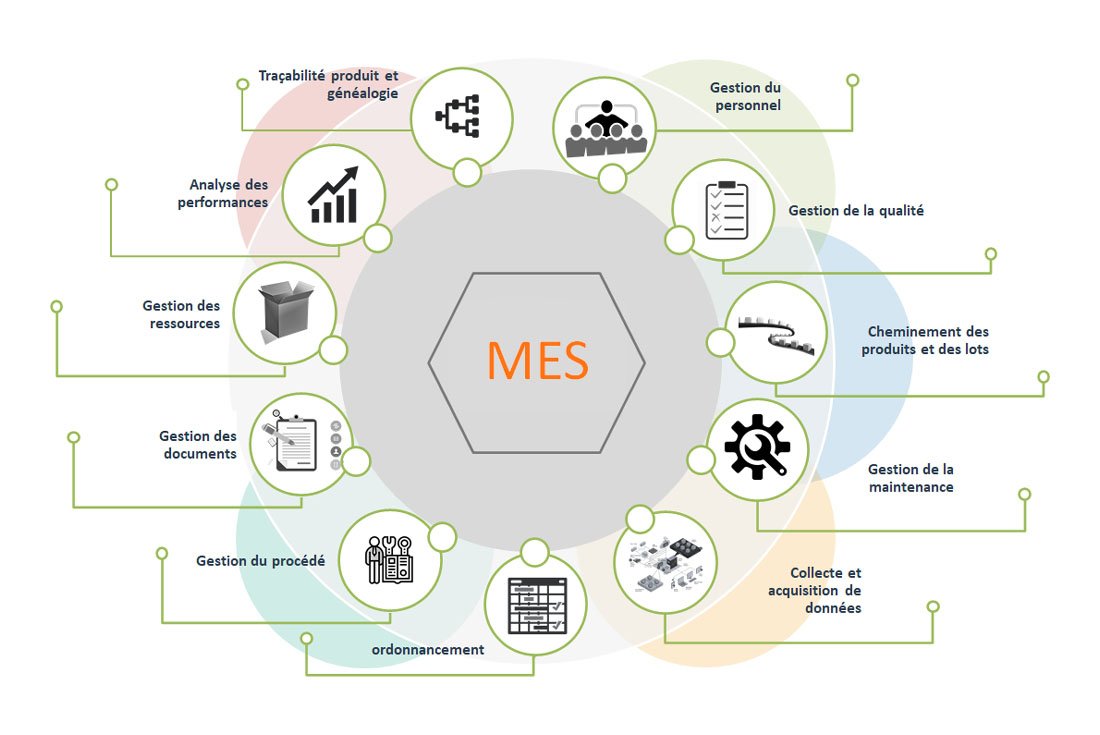
The ANSI/ISA-95 standard defines the 11 fundamental functions of the MES, detailed in our article The 11 main functions of a MES.
To go further, read our article: What is MES software?
The MES, the cement of your efficiency
First of all, MES software lets you centralise the data in your shops and make it communicate. This is only the first step, but it is essential, because it prepares you for the technologies to come. The MES also makes up for gaps in efficiency and “common sense”.
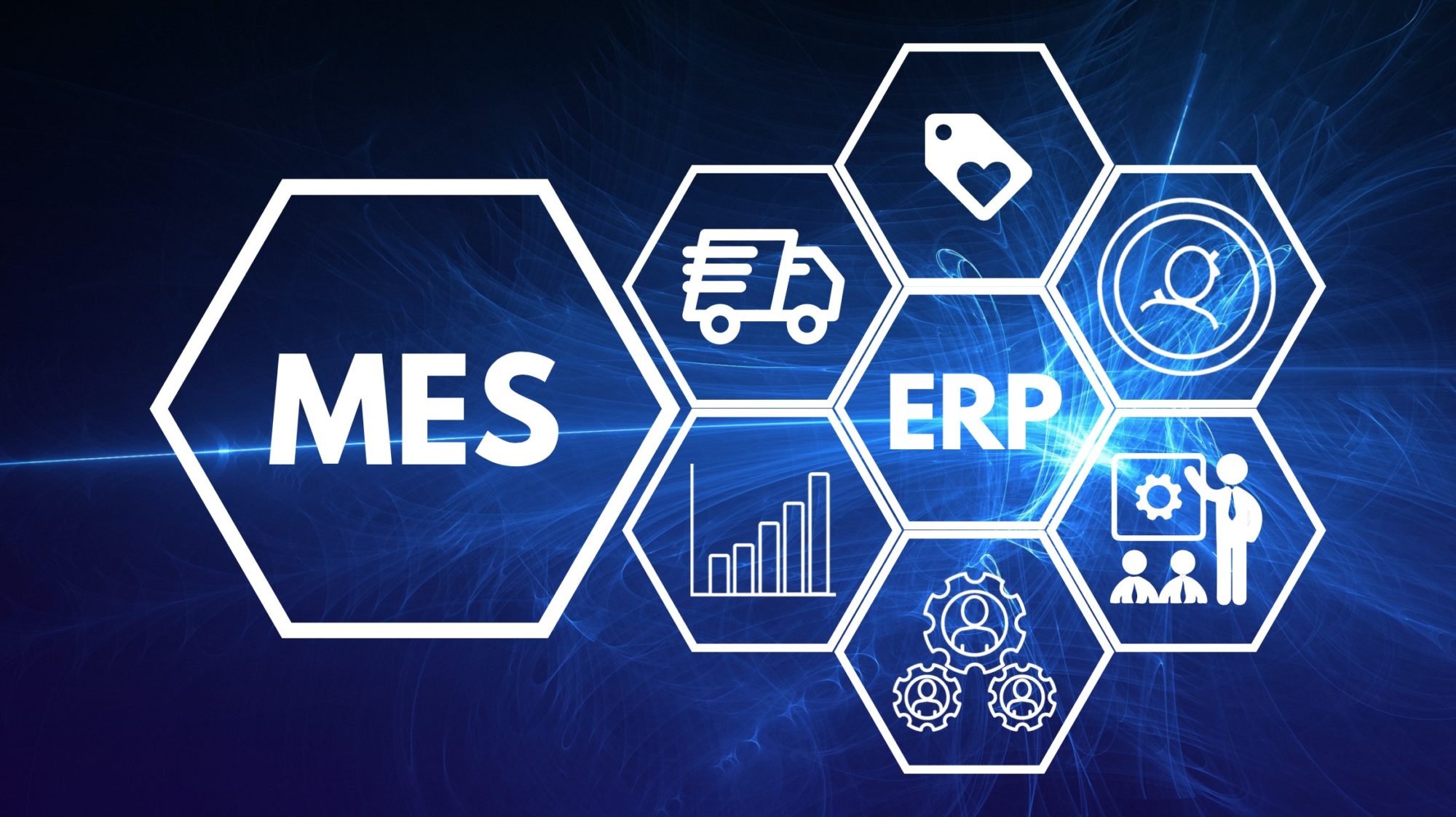
Do you already have solutions in place (an ERP, for example)? Don’t worry: the MES complements this established software and these processes, making the whole more efficient and connected.
A concrete example:
A company assembling mechanical parts for aviation has to carry out quality checks during production. Its specifications require operators to apply a set tightening torque to screws and nuts. The company therefore decided to invest in connected metrology tools (IoT).
This data did not communicate with the company’s ERP, so it was printed out. Information travelled on paper before being re-entered later by an operator. The company found it was losing time and money, with an increased risk of error.
The MES enabled this company to automate this step by going paperless, and to link technologies already in place without any major structural change, achieving a fast ROI (Return On Investment).
The MES therefore delivers a faster return on investment, at far lower cost than robotics or automation, which often come too early in the modernisation of shops and factories.
It is often wiser and more accessible to start by deploying a MES, which optimises what already exists and prepares the ground for more modern production equipment. The MES centralises all the technologies on the shop floor: it is the digital heart of the factory.
The most telling example is buying an automated, robotised line where, at each production stage, data is on paper and sometimes entered several times. This makes the purchase less profitable, especially as the risk of error with every manual entry is high. Choosing a MES to manage these issues first, and acquiring automation afterwards, is therefore generally a better choice for companies.
The MES centralises and cross-checks the data produced by all the other technologies on the shop floor. It is the foundation of digitisation.
How do you choose a MES according to where you are in your transition to Industry 4.0?
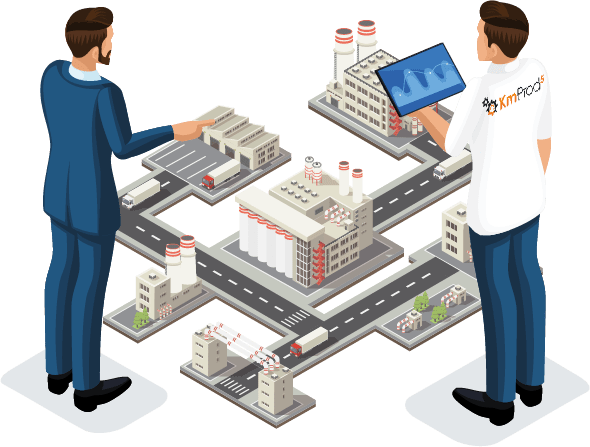
Keeping a watch on the MES software market is important to choose the solution best suited to where you are in your transition to Industry 4.0. Just as crucial is knowing where you stand. An outside opinion and visit may sometimes be needed to draw up the specifications of your needs. Meta 2i can also help at this preliminary stage, with a consulting service that helps you draw up precise, realistic specifications.
So what are the steps for choosing the “right” MES?
Choose a proven MES
Several points must be considered to choose the MES best suited to your needs. Start by checking whether the solutions you are considering have already worked on a project with similar machines and PLCs. This gives you real evidence of the benefits of the MES in question.
Choose a MES suited to your needs and your trade
At Meta 2i, 50% of our projects are tailor-made. If, for example, you already have scheduling that works well, we will not replace it without good reason. We can fill the gaps (nothing will replace what already works, except something that works even better).
A tailor-made MES also avoids rushing operators and lets you support the change smoothly while remaining effective. You are supported by a team experienced in similar and varied projects, which can give the right answers to each organisation’s specific needs.
Tackle problems one at a time
The entry point of a MES project must be a problem.
For example: a company cannot solve its quality management problems. The Meta 2i team will stay at your side on this point until it is solved. Then we can move on to the next step.
Deploying a MES does not solve every problem at once. Production must continue and never stop, so as not to harm the company’s productivity.
KmProd is a complete MES that already addresses all these problems, from the small shop to the large factory. KmProd was created in the shops of our long-standing customers almost 30 years ago and has evolved with technologies and with their needs. It is software that solves manufacturers’ everyday problems, because it was designed by them and for them. It is the result of a great many projects carried out over 30 years in many business sectors, through which KmProd’s operational excellence has been proven.
KmProd’s adaptability will therefore be the key to a successful transition to Industry 4.0.
Now it’s your turn!